All Projects

(02)

One Pixel of Truth

A trusted digital hub connecting fashion designers with verified material suppliers, anchored by a single, transparent sustainability score.

Project type

Product Design, B2B Platform UX, Fashion-tech & Sustainability

Project role

Lead Product Designer, UX Research, IA, UI Design

Date

2026

01

Overview

Consolidating fragmented sourcing.

Consolidating fragmented sourcing.

Designers source sustainable materials through spreadsheets, Pinterest boards and group chats. No centralized, trusted record exists, so every sourcing cycle starts from zero and every claim has to be taken on faith. I led Pixel & Co end to end: research, information architecture and interface; with the goal to unify sourcing, verification and supplier discovery in one platform.

Designers source sustainable materials through spreadsheets, Pinterest boards and group chats. No centralized, trusted record exists, so every sourcing cycle starts from zero and every claim has to be taken on faith. I led Pixel & Co end to end: research, information architecture and interface; with the goal to unify sourcing, verification and supplier discovery in one platform.

02

The problem

Eight broken pieces of one ecosystem.

Eight broken pieces of one ecosystem.

Discovery interviews with designers, suppliers and sustainability educators documented 20+ sourcing barriers. Affinity synthesis reduced them to eight core problems, and those eight resolve into three clusters.

Discovery interviews with designers, suppliers and sustainability educators documented 20+ sourcing barriers. Affinity synthesis reduced them to eight core problems, and those eight resolve into three clusters.

Cluster A · Trust

01

Lack of trust in sustainability claims

Unreliable data and greenwashing, with no way to check a claim.

04

Supplier transparency gaps

Little visibility into material origins or production practices.

Cluster B · Access

02

Fragmented sourcing ecosystem

Materials scattered across directories, certification sites and word-of-mouth.

06

Insufficient collaboration across the value chain

Brands, suppliers and recyclers operate in silos, so shared data moves slowly.

07

Weak incentives & rewards

Few systems motivate designers or consumers to choose circular materials.

Cluster C · Standards

03

Complex & inconsistent certifications

Competing certification frameworks create confusion about what a badge means.

05

Limited education & awareness

Designers lack grounding in sustainability standards and materials science.

08

No standardized sustainability data

No unified metric exists to compare materials, so decisions stay subjective.

03

The solution

One platform. Verified claims. Connected ecosystem.

One platform. Verified claims. Connected ecosystem.

Three jobs the platform has to do, each answering a theme from the research.

Three jobs the platform has to do, each answering a theme from the research.

01 / trust

One searchable record per material

One searchable record per material

A centralized database of materials, suppliers and certifications, so sourcing stops being reassembled from spreadsheets every season.

A centralized database of materials, suppliers and certifications, so sourcing stops being reassembled from spreadsheets every season.

02 / access

Designers, suppliers and brands in one place

Designers, suppliers and brands in one place

Supplier profiles, shared project data and cross-value-chain tools, so visibility runs both directions instead of stopping at a directory listing.

Supplier profiles, shared project data and cross-value-chain tools, so visibility runs both directions instead of stopping at a directory listing.

03 / standards

Claims linked to their source

Claims linked to their source

Credentials resolve to official registries (GOTS, OEKO-TEX, Bluesign) with transparent methodology, cited evidence and an audit date, all carried by one score.

Credentials resolve to official registries (GOTS, OEKO-TEX, Bluesign) with transparent methodology, cited evidence and an audit date, all carried by one score.

PSI: The Pixel Sustainability Index
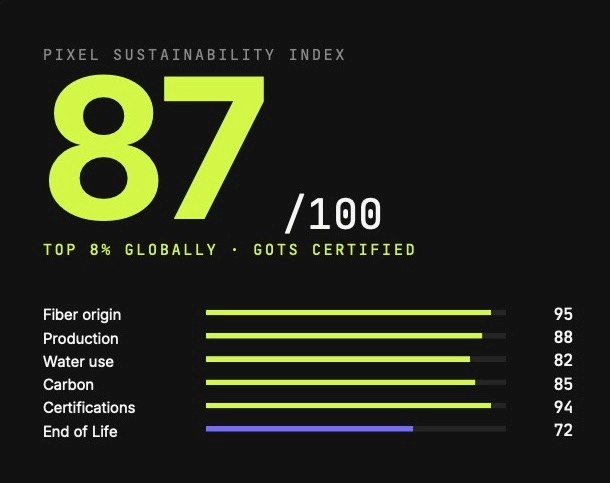
One verified score standing on six categories of evidence. The number carries the claim; the pillars carry the proof.

One verified score standing on six categories of evidence. The number carries the claim; the pillars carry the proof.

04

Impact

Research that shaped the product.

Research that shaped the product.

Every problem the research surfaced traces to a design decision, and every decision traces back to evidence.

Every problem the research surfaced traces to a design decision, and every decision traces back to evidence.

Problem theme

Design decision

Validation

01

Trust gap

Certification library linked to registries

Every credential resolves to its issuing body with a time-stamped audit record, so verification happens inside the platform rather than in a browser tab.

Every

Designer interviewed asked some version of “is this greenwashing?” about the claims they encounter.

02

Fragmentation

Supplier profiles inside the hub

The sourcing trail is visible, sourcing, contacts and certification history sit on the material itself instead of reconstructed.

#1

Pain point across every user group: no centralized, trusted source.

03

Complexity

PSI : one standardized score

Testing showed structure worked but the mission was invisible. A single 0–100 score gave the value proposition a place to appear.

6 → 1

Usability pain points shared one root cause; one metric answered it. Zero participants had named the mission before.

Read the full case study →

Black three-part geometric Paola Mendoza emblem
  • Let’s Work Together -

  • Let’s Work Together -

  • Let’s Work Together -